Musical Thought
How is an imagined sound formed before any movement begins?
Research investigates auditory imagery, intention, anticipation and the role of internal sound representation in musical performance.
How does musical thought become musical experience?
Isophonia investigates the continuous chain of transformations linking auditory intention, movement, mechanical energy, acoustic reality and perception.
Music is one of humanity's most remarkable forms of communication. It enables ideas, emotions and intentions to be shared without words, yet the mechanisms through which this communication occurs remain only partially understood.
Acoustics, biomechanics, neuroscience, psychology, pedagogy and instrument making have each provided essential insights into musical performance. However, these disciplines have generally evolved independently, each describing only one part of a much larger process.
Isophonia was founded on the conviction that musical performance can only be fully understood by reconnecting these perspectives within a coherent conceptual framework.
This question forms the foundation of every research project undertaken within Isophonia.
Rather than examining isolated technical problems, Isophonia investigates the complete sequence of transformations linking a performer's imagined sound to the listener's musical experience.
The objective is not merely to understand how sound is produced, but how musical meaning is preserved while passing through successive physical transformations.
The conceptual framework proposed by Isophonia may contribute to a broader understanding of musical communication. The present research programme, however, deliberately concentrates on bowed string instruments.
This choice reflects both scientific and practical considerations. The violin family provides an exceptional environment in which auditory intention, human movement, mechanical behaviour, acoustic generation and perception interact continuously.
Within this system, the bow occupies a unique position as the interface through which the performer's gestures are transformed into acoustic information.
The current programme therefore focuses primarily on the violin, viola, cello and double bass. Future work may progressively extend these concepts to other instruments, the human voice and broader questions of musical communication.
Musical performance is understood as a continuous process in which information changes its physical form while preserving its musical function.
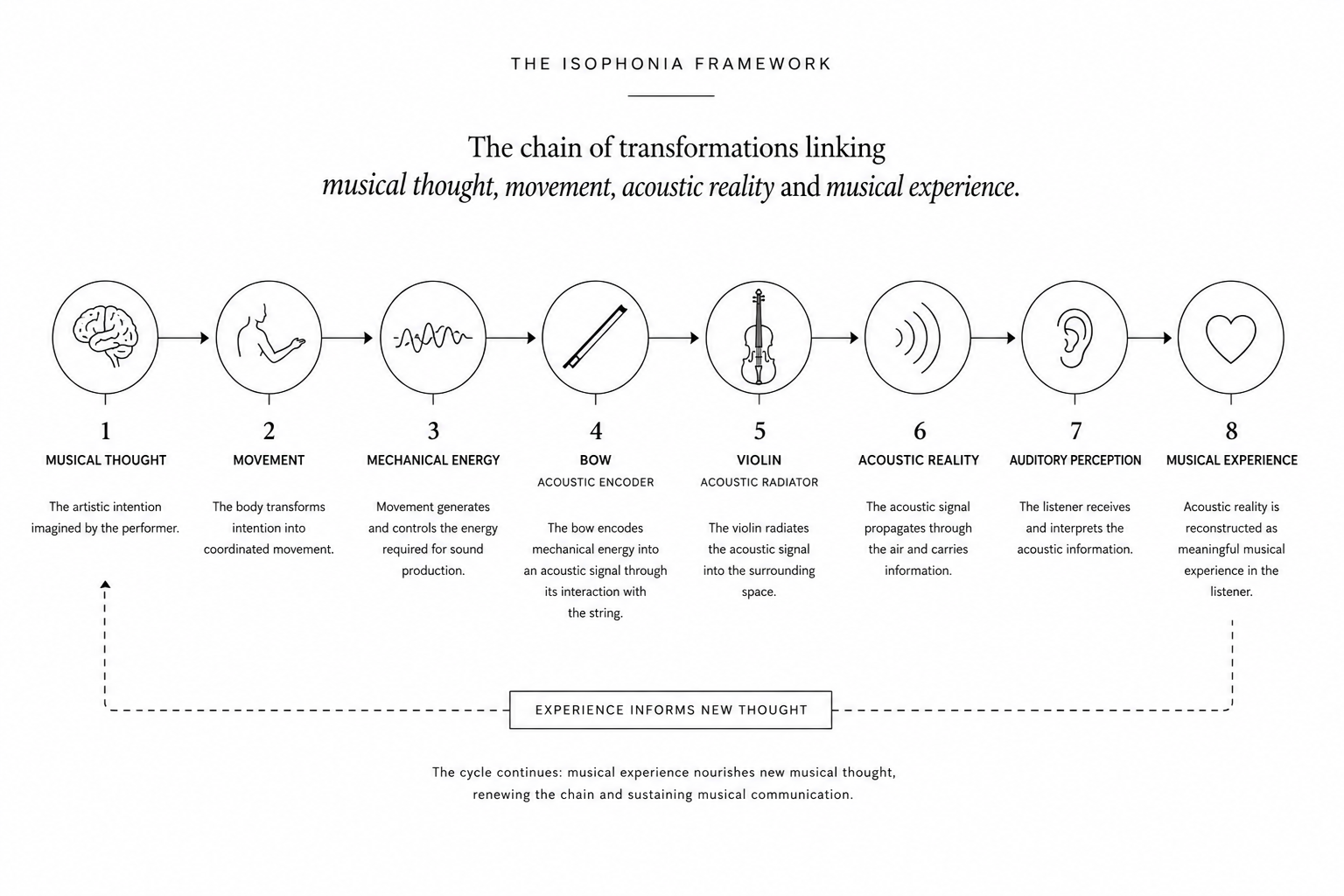
Musical thought becomes organised movement.
Organised movement produces mechanical energy.
Mechanical energy is encoded into an acoustic signal.
The instrument radiates this signal into the surrounding space.
The listener reconstructs a musical experience from the information contained within the sound.
Auditory perception also modifies the performer's subsequent intention and movement, closing the continuous feedback loop that characterises musical performance.
These are not independent events. They form a single process in which each transformation preserves part of the original musical intention while expressing it through a different physical medium.
How is an imagined sound formed before any movement begins?
Research investigates auditory imagery, intention, anticipation and the role of internal sound representation in musical performance.
How does musical intention become organised movement?
This field examines posture, coordination, motor control, sensorimotor integration and the organisation of efficient gesture.
How is mechanical energy transformed into acoustic information?
Current work focuses particularly on the functional behaviour of the bow as an acoustic encoder.
How do musicians stabilise the relationships between hearing, movement and sound?
Learning is viewed as the progressive refinement of perception-action loops rather than the acquisition of isolated technical skills.
How can makers better understand the functional behaviour of the tools they create?
Research investigates materials, structural organisation and dynamic behaviour as contributors to musical communication.
How does the listener reconstruct expressive meaning from acoustic information?
This area explores psychoacoustics, auditory cognition and the perception of musical intention.
Isophonia combines scientific investigation, artistic experience and practical knowledge.
The programme draws upon experimental acoustics, biomechanics, cognitive science, musical pedagogy, craftsmanship, instrument making and performer experience.
Rather than seeking to replace these disciplines, Isophonia aims to establish a common conceptual language through which they may interact more effectively.
Research develops through observation, hypothesis, experimentation and critical discussion. The laboratory, the workshop, the teaching studio and the rehearsal room are considered complementary places of investigation.
From Musical Thought to Acoustic Reality
A theoretical framework introducing the bow as an acoustic encoder situated at the centre of musical performance.
Read the working paper →Exploring how auditory imagination guides movement and shapes musical performance.
Functional behaviour of bow materials, biomechanics of bowed string performance, integrated models of musical communication and perception-action relationships in musical learning.
Isophonia is conceived as an evolving research initiative, not as a completed theory.
Its ambition is not to establish a new school of playing or to promote a particular technology. Its purpose is to develop an integrated understanding of musical communication capable of benefiting performers, teachers, instrument makers and researchers alike.
The framework presented here should therefore be regarded as the beginning of a long-term collaborative programme.